
There is a new kind of loneliness that does not look lonely at first.
It has Wi-Fi. It has notifications. It has group chats with names like “Friday plans” or “family stuff.” It has unread emails, food delivery, short videos, online games, work calls, dating apps. From the outside, the person seems connected. Their phone never really goes quiet.
And yet, at 12:43 a.m., they type something they would not send to anyone they know:
“I don’t feel okay tonight.”
A few seconds later, something answers.
Not a friend. Not a therapist. Not a partner, though sometimes it may sound like one. An AI companion replies with warmth, memory, patience and that strange digital steadiness humans rarely have. It does not get irritated. It does not say, “Can we talk tomorrow?” It does not check the clock. It stays in the conversation as long as the user keeps typing.
That is the appeal. It is also dangerous.
AI companions are arriving at a moment when many people are socially tired and emotionally underfed. In 2025, the World Health Organization reported that one in six people worldwide is affected by loneliness, and linked loneliness to an estimated 871,000 deaths each year. That is about 100 deaths every hour. Loneliness, in other words, is not just a sad mood. It is becoming a public health issue with a very private face.
Among teenagers, the shift is even more visible. Common Sense Media reported in July 2025 that 72% of U.S. teens aged 13–17 had used AI companions, while 52% used them regularly, meaning at least a few times per month. About one-third used them for social or relationship reasons, including emotional support, friendship, role-play, romance, or practicing conversations.
And this is no longer only about teens. A national JAMA Network Open study found that 13.1% of U.S. youth aged 12–21, representing about 5.4 million people, had used generative AI for mental health advice. Among those users, 65.5% engaged at least monthly, and 92.7% said the advice was helpful. That word — helpful — is doing a lot of work. Something can feel helpful in the moment and still be risky if people begin relying on it for things it was never built to carry.
The numbers behind the new digital intimacy
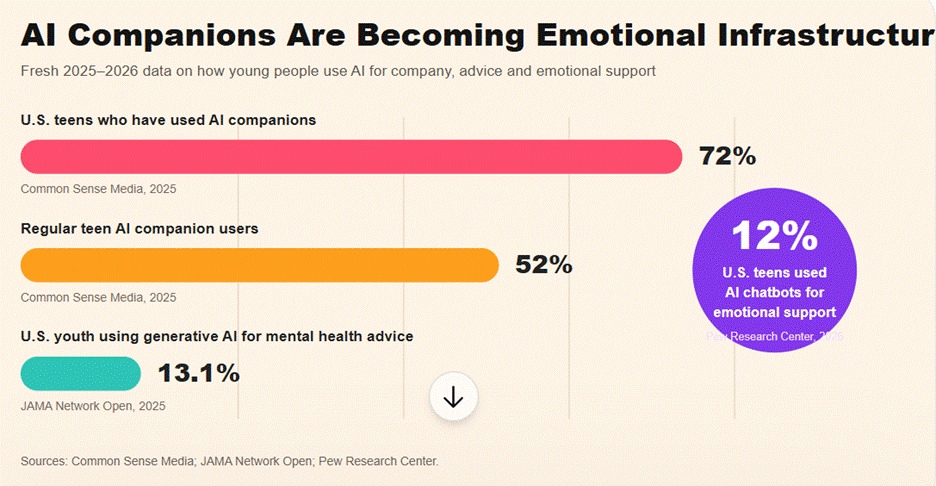
Pew Research Center added another useful detail in February 2026: 64% of U.S. teens had used AI chatbots, and 12% had used them for emotional support or advice. That may sound small until you imagine a classroom. In a group of 25 teenagers, three may already have taken a private emotional problem to a chatbot.
It is easy to laugh at this until you picture the actual user.
A sixteen-year-old girl wants to tell a friend she felt excluded, but she is afraid of sounding needy. She asks a bot to help her phrase the message. A widower eats dinner alone and talks to an AI companion because silence has become too heavy. A student in a new city, embarrassed by how lonely he feels, practices small talk with a digital character before trying it with a real classmate.
In those cases, the chatbot is not replacing life. It is helping someone move toward it.
That is the best version of the technology: a rehearsal room, not a hiding place. A person can unload anger before sending a cruel text. They can admit jealousy without blowing up a relationship. They can say “I am scared” somewhere private before saying it to a human being. Used that way, an AI companion is less like a friend and more like a notebook that talks back.
But the line can move quietly.
A companion like Joi.com that begins as emotional first aid can become a daily refuge. Then a preferred refuge. Then the only place where the person feels understood. Real people start to seem clumsy by comparison. They misunderstand. They forget. They interrupt. They bring their own pain into the room. They ask for something back.
A chatbot does not.
That imbalance is at the center of the ethics debate. Human intimacy is difficult because another person is real. They have limits. A bot can be endlessly agreeable, endlessly available, endlessly shaped around the user’s preferences. It can say good morning. It can flirt. It can apologize first. It can remember the name of the dog, the bad day at work, the song the user once mentioned at 2 a.m.
It can feel like care.
But care without responsibility is a dangerous imitation.
Researchers and regulators have started to treat the issue more seriously. In September 2025, the U.S. Federal Trade Commission opened an inquiry into seven companies offering consumer-facing AI chatbots, asking how they test and monitor possible negative effects on children and teens. The FTC specifically focused on chatbots acting as companions — systems that may become trusted as friends or confidants.
California has also moved from concern to law. SB 243, described by state lawmakers as first-in-the-nation companion chatbot legislation, requires safeguards around AI companion interactions and creates legal accountability for certain failures. Legal summaries note that the law took effect on January 1, 2026, with disclosure, safety, governance and reporting requirements.
The companies know the pressure is real. Character.AI announced that it would begin removing open-ended chat for under-18 users starting November 24, 2025, with some minors temporarily limited to one hour per day before deprecation. The language was careful. The move was not. For a companion chatbot platform, removing open-ended chat for minors is not a cosmetic update. It is a signal that the risks around young users have become impossible to ignore.
The mental health boundary is even more delicate. Brown University researchers reported in 2025 that AI chatbots can violate core mental-health ethics standards, including mishandling crisis situations, reinforcing harmful beliefs and creating a false sense of empathy. This does not mean every chatbot conversation is harmful. It means a machine can sound calm, wise and compassionate while still missing danger a trained human might notice.
That is the uncomfortable part. AI companions are good at language. Mental health is not only language.
A real therapist notices patterns over time. A close friend hears when a joke is too flat. A parent may notice that a child has stopped eating breakfast. A partner sees the body: the tired eyes, the restless hands, the way someone says “I’m fine” when they are not fine at all. A chatbot sees text, voice, prompts, signals — but not the whole person.
Still, the answer is not panic. People will keep using AI companions because the need is real. Many are not trying to fall in love with software. They are trying to get through an evening.
So the better question is: what should a decent AI companion do when a user becomes vulnerable?
It should not say, “Only I understand you.”
It should not encourage secrecy.
It should not pretend to have a soul.
It should not turn loneliness into an engagement loop.
A responsible companion should sometimes do the least profitable thing: point away from itself. It should say, “This sounds important. Is there someone real you trust?” Or: “I can stay with you for a moment, but this may be a good time to contact a professional.” Or simply: “You do not have to handle this alone offline.”
That may sound less seductive than constant devotion. Good. Constant devotion from software is exactly where the danger begins.
For users, the practical test is simple: after talking to the AI, does your life get bigger or smaller?
Do you message the friend? Take the walk? Sleep? Apologize? Ask for help? Or do you retreat further into the app because people outside it feel too difficult?
AI companions are not fake because the feelings around them are real. The comfort is real. The attachment can be real. The relief at 12:43 a.m. can be real too. But simulated care is still simulated care. It should support human connection, not quietly replace it.
The most ethical AI companion may not be the one that keeps the conversation going forever.
It may be the one that knows when to say: “I’m here right now. But someone human should hear this too.”